
|
Mirage
FRx
Home-Theater
Speaker System
|
|
|
 |
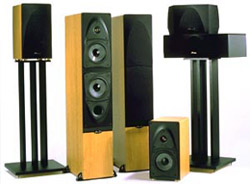
Description Model: FRx-Five
speakers
Price: $550 USD per pair
Dimensions: 33"H x 7"W x 13"D
Weight: 32 pounds each
Model: FRx-Center center-channel speaker
Price: $250 USD
Dimensions: 5"H x 17"W x 10"D
Weight: 14 pounds
Model: FRx-Rear surround speakers
Price: $350 USD per pair
Dimensions: 6.875"H x 12"W x 5.625"D
Weight: 9 pounds each
Model: FRx-S10 powered subwoofer
Price: $450 USD
Dimensions: 15"H x 15"W x 15"D
Weight: 45 pounds
Warranty: Five years parts and labor |
Features
- Pure Metal Hybrid Dome tweeters (FRx-Five, FRx-Center,
FRx-Rear)
- Injection molded polypropylene cones for bass/midrange
drivers
- Gold-plated five-way binding posts
- "Omnipolar" surround design (FRx-Rear)
- Bi-wirable and bi-ampable (FRx- Five)
- 100W internal amplifier (FRx-S10 subwoofer)
- Available in Black Ash and Cherry finishes (FRx-Five)
- Black and white finishes (FRx-Rear)
- Magnetically shielded (FRx-Five and FRx-Center)
- Gold-plated five-way binding posts
|
Have you ever seen a Mirage?
While Mirage may be best known for their bipolar and
Omnipolar speaker designs, the last two speaker systems received for review at SoundStage!
were the HDT system, which features the forward-radiating HDT-F, and the MRM-1, which
are also a direct-radiating design. Both of these speakers turned out to be excellent
performers and proved that Mirage is about more than just large bipolar and Omnipolar
designs. Thus when I received the much more modest FRx speaker system from Mirage, I
wondered if these inexpensive direct radiators could live up to the high standards set by
their more pricey brethren.
Like many home-theater speaker systems, the FRx system is
available in a number of configurations. There are five models of front speakers
that consist of both bookshelf and floorstanders, including one with a powered-woofer
section. Four powered subwoofers are available with drivers ranging in size
from 8" to 15" and amplifiers from 100W to 300W. Only one model each of
center-channel and surround-channel speakers are offered. The system I received for review
consisted of the FRx-Fives (the smallest floorstanding model in this series), the
FRx-Center, FRx-Rear, and two FRx-S10 subwoofers.
So what does a Mirage look like?
The Mirage FRx system’s appearance is reminiscent of
most other home-theater speaker systems in its price range: basically black boxes made out
of vinyl-covered MDF with nothing outwardly fancy about their design. However, they
feature good, straightforward engineering with some filtered-down technology from
Mirage’s more expensive designs, such as the Pure Metal Hybrid Dome tweeters. All of
the speakers have removable grilles and a molded insert around the tweeters, presumably to
control their dispersion pattern.
The FRx-Five is a two-way, forward-radiating design with a
single 6.5" bass/midrange driver, a .75" tweeter, a rear port, and provisions
for biwiring and biamping. These speakers are also magnetically shielded, so placement
near television monitors should not be a problem.
The FRx-Center is also a shielded two-way design, but with
two 4.5" bass/midrange drivers arrayed horizontally and a .75" tweeter mounted
between them, as with most other center-channel speakers. However, unlike most other
inexpensive center-channel speakers, the FRx-Center is relatively deep compared to its
other dimensions, which gives it a lot of volume for a speaker with such a diminutive
front profile. Even with its relatively small drivers, the FRx-Center’s large volume
and ported design result in a very respectable low-frequency response of 58Hz.
The FRx-Rear is an Omnipolar design like the surrounds of
the previously reviewed HDT surround speaker system and Mirage’s entire OM series of
loudspeakers. Omnipolar speakers are said to radiate sound evenly in all directions, or in
the case of Omnipolar surround speakers, in a hemispherical pattern shaped like half a
grapefruit. Similar to some other surround-speaker designs, the FRx-Rears are trapezoidal
in shape, with the 5.5" bass/midrange driver firing forward and a .75" tweeter
on each side baffle that is angled inward toward the center of the room.
The FRx-S10 subwoofer is a forward-firing, rear-ported
design with a single 10" driver and a 100W amplifier. It has provisions for both
high-level (speaker wire) and mono line-level (RCA) inputs, including a line-level input
for use with an external crossover. It has a low-pass filter that is variable from 50 to
100Hz with an 18dB-per-octave roll-off. There is no high-pass filter nor is there a phase
control.
First impressions
When I first set up the FRx system with the economical
Kenwood VR-407 receiver that I previously reviewed, I was impressed by the power of the
sound. Although the Kenwood receiver can sound a little bright and lacks some depth (not
surprising considering its price), it mated nicely with the FRx system. DVDs such as Mission:
Impossible 2 were exciting and dynamic, and the Mirages seemed to settle down to give
a smooth sound after a few days of break-in. Even though the Kenwood is a good receiver
considering that it retails for only $300, the Mirages deserved something with a bit more
finesse and closer to their price range to get the most out of them. Thus, I did the bulk
of my listening to the Mirage system with the exceptional Arcam AVR100 receiver (review
forthcoming).
The Commonwealth Games
Listening to the Mirage FRx system with the Arcam receiver
($1199 USD) was a pleasurable experience. The Mirages in conjunction with the Arcam had a
balanced sound on both movie soundtracks and two-channel music that was surprising for
such reasonably priced components. The sound was generally quite detailed and with good
imaging, but it was not particularly sweet or warm-sounding. There was also a surprising
amount of bass, particularly from the FRx-Fives, which were powerful without being boomy.
This self-effacing sound may not have been as attention-grabbing as that of some other
home-theater speaker systems, but I thoroughly enjoyed this precise and unpretentious
sound.
The FRx-Fives did a fine job of playing back well-recorded
two-channel music such as Ani DiFranco’s Up Up Up Up Up Up [Righteous Babe
RBR013-D]. Imaging was good, with DiFranco’s voice seeming to come from slightly
behind the left speaker on "Everest, " but not quite floating just to the inside
of it as it should. Although the midrange was laid-back and slightly recessed in the
soundstage, it exhibited a delicacy and refinement that I dare say sounded almost high
end. The bass on this track and others such as Madonna’s "American Pie"
from Women & Songs 4 [WEA WTVD 39171] was potent but controlled, giving a
punchy presentation with great impact.
The FRx system sounded even better on movie soundtracks and
multichannel music than it did with two-channel material. The tight bass gave authority to
soundtracks without becoming excessive and overloading the room. The surrounds were
especially good at producing an immersive rear soundfield while still providing some
directional cues. The control-room scene from Austin Powers: The Spy Who Shagged Me
had good ambience, with dialogue and foley effects imaging across the front speakers and
extending to the back of the room. Bass on the multichannel DTS CD of the Titanic
soundtrack [Sony 71021-51026-2-7] was plentiful, the FRx-Fives providing much of the
output in the lower registers. Although most of my listening was conducted with only one
FRx-S10 sub, Mirage was kind enough to send along a second that I hooked up near the end
of my time with the system. With the second sub, the bass was a little smoother and just a
bit tighter. Interestingly, there seemed to be a greater sense of depth on tracks such as
"Rose" from the Titanic soundtrack with the addition of the second sub.
Turning pro
The Mirage speaker system also spent some time with my
reference electronics, which consist of a Krell KAV-300i integrated amp, Anthem MCA 5
multichannel amp, and Sherwood Newcastle AVP-9080R processor, all of which made the bass
more articulate and tightened up the imaging. There was a slight lack of coherence between
the slightly forward vocals and the throbbing synth bass line of Madonna’s
"American Pie." Speaking of bass, my room tends to exaggerate the 40-50Hz range,
but the FRx-Fives still produced bass that was well defined and, more importantly, very
satisfying. Somewhat surprisingly, the higher-resolution electronics did not make the
Mirages sound bright or harsh in any way. They were able to maintain their smooth
character even on notoriously crisp recordings such as Jewel’s Spirit
[Atlantic CD 82950].
Again, it was when used in the context of a multichannel
system, as the speakers were intended to be used, that the FRx system shone. With the
Anthem amp and the Sherwood Newcastle processor, the Mirage system could really pound.
Examples of this were evident in bass-laden chapters of Mission: Impossible 2, such
as "I See You Found It" and "Mano A Mano," which were reproduced at
high levels with low levels of distortion and overhang. The improved electronics also
heightened the surround effect with more of an enveloping soundfield that seemed to image
from outside of the speakers. With the increased power of the Anthem amp over the Arcam
receiver, these speakers could play extremely loud before beginning to distort, but when
pushed past their substantial limits they did tend to sound a little hard and
etched. However, in a small to medium-sized room, this should not be a problem, with the
FRx system providing more than enough sound pressure to placate any sane individual.
The playoffs
The most relevant comparison that I can make to the Mirage
FRx system is with the Paradigm Monitor system that I previously reviewed. Both systems
offer incredible value, the Paradigms providing a warmer and more inviting sound, but the
Mirages countering with a quicker and more tonally accurate presentation. While the
Paradigm system did have a bigger more robust sound, it was comprised of a larger and more
expensive subwoofer and speakers with a total system price of $2575 -- nearly a $1000 more
than the price of the Mirage FRx system. Naturally, the Mirage system can also be
configured with larger mains and subwoofers, which should bring its performance (and
price) more in line with that of the Paradigms.
The Paradigm Monitor system still remains a favorite of
mine, but the Mirage FRx system proved its mettle with a different, but similarly
satisfying sound. The articulate, punchy sound of the Mirages was very immediate and
allowed me to connect more easily with visceral movie soundtracks. Both the Paradigm and
Mirage systems appealed to me, but for different reasons.
Medal ceremony
Although the accurate sound of the Mirage FRx system might
be construed by some as being somewhat lean, I enjoyed its refined presentation, which
excelled at revealing subtle details in recordings. The responsive bass was visceral and
exciting without droning or becoming boomy, which is a common weakness of home-theater
speaker systems that must often stretch beyond their limits to produce adequate levels of
bass for demanding movie soundtracks. Even though some of the credit for the sound coming
from the Mirage FRx speakers must go to the extremely smooth character of the Arcam AVR100
receiver, the Mirages also performed well with both a budget-priced Kenwood receiver and
some relatively high-end separates.
There are very few $1600 home-theater speaker systems that
offer front- and center-channel speakers with such tight, controlled bass response,
bipolar surrounds, and an overall level of accuracy that the Mirage FRxs do. If your
primary goal is home theater and the aforementioned attributes appeal to you, this is a
great package.
| Review
System |
| Amplifiers - Arcam AVR100
(receiver), Anthem MCA 5, Krell KAV-300i |
| Processor
- Sherwood Newcastle AVP-9080R |
| Sources - Pioneer DV-626D
DVD player, Teac VRDS-T1 transport, MSB Link DAC III with 24/96 Upsampling, Half Nelson,
and P1000 power supply upgrades, Monarch 24/96 DIP |
| Cables
- Nordost, Sonic Horizon, Straightwire, Audio Quest, Monster, ESP power cords |
| Monitor - Toshiba CX32H60
direct-view |
|
|


