|

PLUS
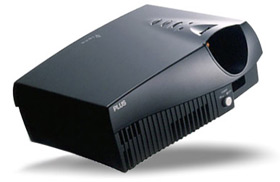
HE-3100 Piano
DLP Projector
|
|
|
 |
Description Model: HE-3100 Piano DLP projector
Price: $2999 USD
Dimensions: 9.3"W x 7.8"D x 3.6"H
Weight: 4.4 pounds
Warranty: Two years parts and labor (90
days on bulb)
Features
- Texas Instruments DLP technology
- Single-chip DMD (Digital Micromirror Device)
- Component (RCA), S-video, composite inputs
- Video input (composite, S-video): NTSC 3.58, NTSC 4.43, PAL,
PAL N, PAL M, PAL60, SECAM
- Digital RGB (DVI-D) input (T.M.D.S. compliant)
|
Features (cont'd)
- 450 ANSI lumens (brightness)
- 700:1 contrast ratio
- 508,800 Pixels (848 x 600) resolution
- 36" to 200" image size
- 16.7 million colors (simultaneously)
- 130W high-performance compact lamp
- 32dBA noise level
- Manual focus
- Brightness, contrast, tint, sharpness, color temperature
adjustments
- Projection angle control
- Digital keystone correction
- Gamma correction
- Remote control
- Storage case
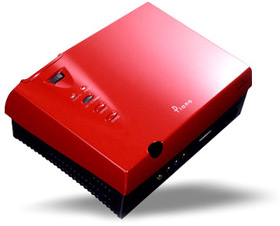
- Available in white, blue, silver, red and black finishes
|
The new PLUS HE-3100, code-named Piano, has
been getting the kind of underground whispers most manufacturers can only dream of. Check
any Usenet group or chat room devoted to the art of visual reproduction and you’ll
find myriad posts about the Piano. HT&S was among the first in the United
States to get one -- and now we're getting the word out to our readers.
The Piano is based on Texas Instruments’ DLP digital
chip for projectors (see November’s "The Director's
Chair" for an in-depth description). Most commonly used in professional
projectors aimed at the presentation crowd, this little chip has been a favorite of
tweakers, who have been hot-rodding it for a couple of years for use in the home. The main
problem with presentation projectors is that they are maximized for brightness, not film
quality. They look great with PowerPoint presentations, but when you run a DVD through
them, the picture looks washed out from the lack of blacks.
PLUS Vision Corporation of Japan, one of the largest
manufacturers of presentation projectors in the world, looked around and thought they
might like to throw their hat in the ring with the home-theater market. So they changed
the internal workings of their color wheel to highlight color saturation and contrast over
brightness, added a Silicon Image chip set that obviated the need for an expensive scaler,
and voilà, the Piano was born.
Other manufacturers have done something similar -- at
around $10,000. PLUS decided to sell their effort for $2999 USD. If it proven at all good,
the Piano would be setting a new standard. Talk about a shot across the bows of the
biggies in the home-theater industry! While the price is immediately attractive, all would
be for naught if the Piano didn’t produce a good picture delivered by a package
capable of drawing folks to the PLUS brand. So how did they do?
 Set up Set up
Let’s start with the package. For a comparative frame
of reference, my Runco Cinema 750 projector weighs over 100 pounds and is the size of a
two-drawer legal file cabinet. The PLUS, on the other hand -- well, let’s just say
when UPS delivered it, my wife carried it in under her arm and thought it was a little box
of CDs. After we opened it, we were amazed to see that its footprint is smaller than an
8" x 11" sheet of paper -- and its weight is a trifling 4.4 pounds! For the
decorating conscious, not only is this Piano small but it also comes in five different
colors.
Choosing a location for the Piano is a piece of cake. It is
happy mounted above or below the screen and can be used as a front or rear projector.
Noise is lower than any bulb-driven unit I’ve experienced, so if you want to place
the Piano right in front of you, it won’t be too unsettling. PLUS has also managed
light-spill better than most. So the projector shouldn’t provide much visual
distraction from the business at hand.
The only problem you might have with installation is
the on/off switch. It is on the front of the player and is not addressable by the remote.
Therefore, you have to be able to lay your hands on the machine, a potential problem if
you mount it on the ceiling. Since the fan runs whenever the Piano is on, ceiling-mounters
will have a constant fan. You can always hook up a wall switch, but be sure to remember
that the fan must run for several minutes after shutdown. If not, you’ll be replacing
your very expensive light bulb a lot more often than you want to.
The PLUS Piano also comes with a small remote control. The
simple-to-use unit includes an input selector, control of the aspect ratio and on-screen
menu operations, and the on/standby button.
The manual is translated from Japanese a little too
literally, but it contains all the needed info. Setup of the Piano is a breeze. Use the
conversion table in the manual and figure the distance based on the size of your screen.
Center it, square it up, manually focus the lens and you are watching your new projector!
The setup menus are the embodiment of simplicity -- none of the browbeating associated
with the manual convergence of CRTs. Hallelujah!
Computer users will be happy to see a DVI-D input on the
back. I decided to start with two different DVD players, a Pioneer DV-434 and a Sony
DVP-NS700P, using Straight Wire Ghost Buster cables hooked into the component inputs.
After trying to use the progressive-scan outputs from both DVD players, I finally figured
out that the PLUS doesn’t accept them. The Piano asks for an interlaced input, and
then uses the internal Silicon Image 503 chip set (also used in the ultra-high-quality
Princeton monitors and the DVDO iScan Pro) to convert the signal to progressive and detect
3-2 pulldown. This means the Piano depends on the quality of the SI 503 (see www.siimage.com/products/sii503.asp
for an excellent introduction to the system) for extracting the best from the interlaced
input and converting it internally to progressive scan. It worked beautifully.
The big picture
The picture is what really put a grin on my face. Starting
with the Sony DVD player, I watched Austin Powers: The Spy Who Shagged Me. When
Austin is catapulted back to the 1960s in his VW, the Piano threw us back in a time warp.
The picture was so good, I lost track of my purpose for a few minutes and just fell in
love with the colors: deep, well-saturated primary colors that burst off the screen. No
artifacts, no crawlies, no jaggies.
| Take two with Jeff Fritz Having been impressed at CEDIA Expo 2001 by the PLUS Piano, I was
very interested to hook up the little Piano in my home-theater system. In Indianapolis,
the movie shown in the demo was Vertical Limit, so that was one of the first movies
I watched at home. I wanted to see if using the same movie on DVD would produce the same
impression.
I remember commenting to my fellow SoundStage! Network
colleague Roger Kanno that the skin tones of the actors during the mountaintop close-ups
were vivid. Well, I have good news! The whiskers, skin chaffing, and rosy hues of the
player's faces were displayed with excellent detail and color. I was as close as I wanted
to be, and with all the excitement I could handle. This movie impressed me again over the
Piano. Déjà vu.
Moving on to one of my favorite films of all time, the 16:9
Braveheart, I was thrilled. The color of the landscape was presented with good
contrast, which was made even more compelling due to the widescreen presentation of the
field of battle. Those of you moving up from a 4:3 monitor in the 27" to 36"
rang will find the 80"-plus PLUS Piano to be truly cinematic by comparison,
especially with a widescreen DVD. I’m not going to use the cliché "size
matters" line, but in this case size does make a difference, especially with a movie
like Braveheart.
I wasn’t finished yet. I couldn’t wait to load Shrek
into my Technics DVD-A10 to see if the colors were displayed with the vibrancy and
diversity I know are present in this truly fun movie. The various characters, including
Shrek himself, looked, well, not real, because they aren’t, but they were really
saturated, especially in the case of Shrek’s green skin! Edge definition was
excellent with no washed-out images. The contrast between competing colors was notable,
making this enjoyable movie even more fantasy-like from a visual perspective.
I had a great time with the PLUS Piano, and my guess is
that you will too. At its price, it is a real-world upgrade possibility to those of you
looking for a larger screen and a wonderful picture to display your DVDs. It’s a
no-fuss, easy-to-set-up and -maintain unit that won’t intrude on your life. DLP
technology is here, it’s affordable, and it works flawlessly in the case of the PLUS
Piano.
...Jeff Fritz
jeff@hometheatersound.com |
|
|
Next up, I tried Dinosaur. The detail was
breathtaking in chapter 3. This gives us our first look at the close-ups of the
monkeys’ faces -- the fur was astounding in its resolution. In fact, the Piano really
excelled with digital-based film. Shrek had texture and depth, a clean picture with
intense colors, especially Shrek’s dazzlingly attractive ogre skin. Final Fantasy
also looked impeccable in detail and color. Again, it is a very dark movie that should
show the typical failing of DLP -- poor blacks. But the Piano provided plenty of punchy
contrast and sufficient picture quality. I forgot reviewing again and just enjoyed the
film.
Citizen Kane is an excellent disc to evaluate a
projector’s ability to resolve countless shades of gray. Gregg Toland’s
groundbreaking B&W cinematography came through with brilliant resolution in this
frequently dark film. Blacks were better than any I’d seen from any digital
projector. They were still not quite the match of those from the best CRTs, but
they were within spittin’ distance. Other than some moiré problems when
Joseph Cotton wore checked coats, everything was perfect.
Switching to the Pioneer DVD player with composite output,
I found that the picture quality dropped drastically. Problems started appearing when I
spun Swordfish. Troubles everywhere: rainbows, crawling dots, total inability to
throw a white field without colors intruding where they shouldn’t. Since the picture
was so right with the Sony, I can only state the obvious: GIGO (garbage in, garbage out).
The same thing happened when using the tuner in my Toshiba S-VHS deck. This was not the
fault of the Piano at all, but it should be obvious that with a piece this good, you want
to feed it high-quality gear. The Pioneer DV-434 looked just fine when I used Straight
Wire Ghost Buster component cables, but not the composite interface.
My Philips DSR 6000 DirecTV with the built-in TIVO system
and the new adaptive-recording-speed system also worked well. Even a venerable Pioneer
laserdisc player provided excellent pictures. We spent one night just auditioning
laserdiscs of old Hollywood musicals, notable for their reliance on primary colors -- and
lots of them. The picture was wonderful in its accurate reproduction of these colors.
But there were a few minor problems. First, the location of
the sensor for remote control makes it necessary that you have a sight line to the back of
the projector. If it is on a table in front of you, you’re in like Flint. In my case,
I have the Piano set up as a rear projector, which means any setup changes I have to do
are a pain. I recommend that anyone not using a front-projected table mount invest the few
dollars in acquiring a remote-control extender. Second, because the Piano has a fixed
lens, its distance to the screen is non-negotiable. Personally, I’ll take the
dramatic cost savings and figure out a way to put it where it needs to be. But if you have
no choice in the matter, be aware of this limitation.
Note the light output of 450 lumens. I have a
light-controlled room, and the picture never looked less than vibrant. But the Piano
cannot to be used in a room with lots of ambient light. If PLUS had hiked the light level
of the Piano, the unit's ability to throw a convincing black would go out the window. I
think they chose the right trade-off. Finally, the PLUS does not present HDTV at full
resolution. The DLP is 848 by 600 pixels. That gives you a clean 800 by 600 for 4:3
sources, and still allows you 848 by 480 resolution, so that you can get the full 480
lines offered by DVD. Again, this is a smart trade-off.
So who is the PLUS Piano for? Let me start by saying it is
not for folks who must have the final bit of HD resolution. It is also a bust if you
can’t control the light in your room (but then, so is every other high-resolution
display device). Other than these, this is a breakthrough product for the rest of us. Do
you find the rear-projector boxes too small? The PLUS Piano goes comfortably to 120"
diagonal. Above that, the pixels start to become visible in large areas of white. Want the
space savings of a flat-screen plasma TV? I’m advising a friend to look at a power
drop-down screen and an innocuous mounting for the PLUS on top of his shelf system. No
space taken, and the combination costs less than a plasma TV one-quarter the size! Do you
mostly watch DVDs? The Piano is a perfect projector for DVD. Built-in internal conversion
to progressive scan and 480 lines of resolution to match the DVD’s 480 lines make it
a great choice.
But most important of all, the price! Other DLP
possibilities are coming soon to a store near you. I’ve had the opportunity to check
out the new Sharp XV Z9000U, a projector with almost twice the pixel count and double the
brightness of the Piano. With DVD, I’m not sure the Sharp is any better. For sporting
events in HDTV, the Sharp has a clear advantage. But the price is $10,000. Other
possibilities include the Dwin Transvision ($13,000), Yamaha DPX-1 ($9995) and the Runco
VX 101C ($9995). All of these are over three times the price of the PLUS Piano.
Color me impressed
Does it sound like I’m impressed with the Piano? I am.
Every night, we looked forward to seeing a new DVD on the Piano. The picture was so strong
it simply drew us into the movie. I’ve been struggling for an audio analogy for how
important this product is. The closest I could come is the original 1970s Advent
loudspeaker, a standard-setting product capable of blowing away speakers at three times
its cost. I can’t think of any other current product that has the chance to dominate
its competition like the PLUS Piano.
I’ve also tried to come up with competitive items to
recommend to you. I can’t. You can get a comparable picture, but at three times the
cost. That’s not competition. This is a superb projector at a terrific price, and
it's intelligently designed by clever engineers. The PLUS Piano has just energized the
entire large-display market, and thankfully we are the winners.
| Review
System |
| Speakers - ATC SMC 50A
(mains), Sonance Symphony (surrounds), KEF Model 100 (center), Sunfire True Subwoofers
(2), Sunfire True Subwoofer Signature, Bohlender Graebner Radia X3 (mains and surrounds),
Bohlender Graebner Radia X1 (center) |
| Processor
- Lexicon MC-1 |
| Amplifier - B&K Video 5 |
| Sources
- Pioneer DV-434, Sony DVP-NS700P, Philips DSR 6000 (DirecTV/TIVO) |
| Cables - Canare GS-6 interconnects,
Monster Cable speaker cable, Straight Wire Ghost Buster video cable |
| Projector
- Runco Cinema 750 |
|
|


