
|
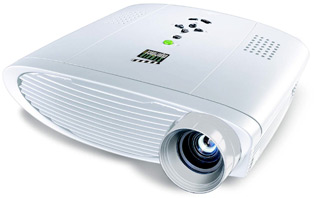
Boxlight Studio Experience
Cinema 12SF
DLP Projector
|
|
|
 |
Description Model:
Boxlight Studio Experience Cinema 12SF
Price: $4999 USD
Dimensions: 10.4"W x 12.1"D x 3.3"H
Weight: 6.1 pounds
Warranty: Three years parts and labor (120
days on lamp)
Features
- Texas Instruments DLP technology
- Single-chip DMD (Digital Micromirror device)
- 508,800 pixels (848 x 600)
|
Features (cont'd)
- 40" to 200" image size
- 1000 ANSI lumens (Brightness)
- 600:1 contrast ratio
- 1080i, 720p, 576i, 480p, 480i compatible
- 220W high-pressure mercury lamp
- 16.7 million colors
- 1.2x zoom lens
- Digital keystone correction
- Manual zoom and focus
- Inputs: M1-DA analog/digital for computer or component,
VESA, computer mini-jack, RCA component, S-video, RCA composite
- Video supported: NTSC, NTSC 4.43, PAL, PAL-M, PAL-N, PAL-60,
SECAM
- 3W speaker system
- Remote control
|
The hardware
The Boxlight Studio Experience Cinema 12SF comes with the
Texas Instruments (TI) Dual Mode DLP chip, an ideal choice for folks who watch mostly DVD
and regular-definition broadcast TV. This is the same chip used in the PLUS Pianos, the
Runco CL-500, the InFocus ScreenPlay 110, and the SIM2 Seleco HT200. TI calls it Dual
Mode because you can set the projector at 848 x 480 for 16:9 sources or at 800 x 600
for 4:3 material.
The projector comes with DVI (analog or digital), S-video,
and composite video inputs. However, in a stroke of consumer-loving genius, they have
developed a seemingly future-proof system. They call it the Enhanced Connectivity Module
(ECM). It is a snap-in piece that attaches to the back, and plugs into the projector
through the DVI input. Once in, it allows you to accept DVI, VGA RGB, component,
composite, and S-video signals. Let’s hope Jack Valenti can quickly decide to quit
squandering our time and his member’s money and allow a digital-connection standard
to pass. With the ECM, virtually any of the currently proposed standards are already
covered, and if they come up with something truly draconian, all you would have to do is
buy a new and up-to-date ECM. Obviously, somewhere in the company, there is an engineer
who is also a home-theater buff. Thank you.
One way to make sure consumers show some interest in your
product is to put the name Faroudja on it. The 12SF carries the DCDi badge, which is a
grouping of four Faroudja features gathered in their FLI2200 chipset. First is the Film
Mode Detection, Faroudja’s patented inverse 3:2 pulldown system for film. Second is
Cross Color Suppression, a way of separating the chroma and luma in a composite signal.
Third is Per Pixel Motion Adaptivity, which uses complex algorithms to keep the definition
as high as possible without showing motion artifacts. The final feature is Directional
Correlational De-interlacing, a system to reduce jagged edges on video-based material.
There are several other nice design features. One of the
down sides of most fixed-pixel projectors is the need to change the light bulb every 1000
hours. The 12SF goes 2000 hours. Their bulb puts out 1000 lumens, a boon to those with
less-than-perfect light control in the viewing room. Some folks look at DLP projectors and
see rainbow artifacts. The 12SF has a six-segment, 4x-speed wheel to stop the rainbows.
Unlike the PLUS Piano
HE-3100 we reviewed last December, the 12SF will take a 1080i or 720p signal, though
either will be down-converted. Like most DLP projectors, the 12SF is light and small, but
the ease of installation could use a tweak.
Setup
Everything starts nicely when you remove the projector from
its box. It comes well packed and includes a soft carry case, a computer cable, A/V cable,
and very well written manual (except parts of the index are off by two pages). After
popping in the ECM, you can hook-up almost anything. Alas, centering the picture on the
screen was a pain. The 12SF uses what they call an "elevator foot" to set the
projector’s vertical centering. It is a drop-down foot that locks when you get it
into place. It is not precise. Situating it reminded me of setting the vertical tracking
angle on a cartridge with its constant set-try-set-try experimentation. The tweak they
should consider is adding a threaded stem. How much could that cost? Other than the
elevator foot, the installation was the soul of simplicity.
Set up was also fairly undemanding. The 12SF hunts for an
active source, then checks the signal and sets about, as the screen says, "perfecting
the image." The only time the projector would get confused was when I switched the NAD T571
between 480p and 480i. The 12SF would go into convulsions and the only way to stop it was
to change the input manually to something else, and then back again. Setting the specific
picture parameters was more complicated.
Again, that videophile engineer showed consideration by
giving us deep access to settings, but the GUI takes too many steps to arrive at the
simple stuff. Let’s say you didn’t know if your DVD was enhanced or plain
letterbox. This is handled on the Resize screen. Switching from anamorphic to
letterbox and back takes 29 key pushes. That’s too many. Instead, why couldn’t
they change the two big PowerPoint buttons (leftovers from its presentation-market
ancestors) and have them scroll through the Resize options?
One thing that will make you nervous when you flip the
switch is the amount of light leakage coming from the front of the projector. I was sure
it was a problem, so I rigged an opaque, black felt screen with a lens-sized hole in it
and sat it in front of the projector. With no picture, it definitely prevented the
unwanted light from hitting the screen and gave a much darker gray. Then I tried a dark
DVD (Rashomon) and let watchers guess whether I was masking the spurious light with
the felt. No one could accurately tell. The bottom line: Yes, there is light escaping, but
it isn’t bright enough to affect the contrast.
Performance
The picture is fabulous. Texas Instruments' DLP chip is
ubiquitous in the presentation market and getting that way in home theater. The reason is
simple -- it works. And it has fewer unwanted side effects than CRT (set up, maintenance,
and cost), LCD (burnt pixels and screendooring), or D-ILA (cost, heat, and light spill).
What separates the 12SF from other DLP offerings is the integration of Faroudja
processing. However, let me tell you a cautionary tale.
When I started critically watching, I used the 480p
settings on each of the DVD players I had. I noticed some weird artifacts. The film
credits from Ocean’s Eleven were particularly bad. When a credit would slide
by, the motion would cause a temporary, dusty look on the screen. After trying three DVD
players, I called Studio Experience technical support. They said the processors were
probably being overworked. I called Faroudja and they told me to switch the DVD players
from progressive scan to interlaced and see if the problem went away. It did.
The reason is that the Faroudja processing is totally
bypassed when you set the 12SF to component input and the DVD player to progressive scan.
Take my advice. Go ahead and use the component outs, but set the DVD player to interlaced.
Unless you have a multi-thousand-dollar state-of-the-art DVD player, you’ll probably
get the best results from letting the Faroudja processor in the 12SF do all the heavy
lifting.
From the moment I finished setting up the projector, it
looked sensational. I started with the menu page from Austin Powers: The Spy Who
Shagged Me to align the picture on my screen. Its bright 16:9 picture eases the job of
setting up a rear projector. I usually switch to chapter 10 where Austin is catapulted
back to the 1960s in his VW. Through the 12SF, the primary colors were deeply saturated
with fantastic contrast. There were no visible problems as the camera panned around all of
the geometrical shapes.
The opening of Dinosaur always elicits oohs and aahs
when I show it to people who haven’t experienced a good home theater. Occasionally,
the mix of film and computer-generated images (CGI) can play havoc with a projector. The
detail through the 12SF was the best I’ve seen in my home; better even than the PLUS
Piano.
I wanted to try a really dark film to check how well the
12SF compensated for DLP’s inherent inability to project black. Warner Brothers’
DVD of Citizen
Kane features brilliant use of dark grays and blacks, and is phenomenally well
mastered. The 12SF’s blacks beat my Runco 750. I have no doubt that one of the
$30,000-and-up CRTs could beat the Boxlight, but the blacks were never distracting.
In the Mood for Love
(Hua Yang Nian Hua) is another dark film, but one shot in beautiful pastel shades.
Again, the 12SF was imperturbable, allowing every texture in the rich Chinese fabrics to
show through with distinct detail.
Comparison
When we originally reviewed the PLUS Piano HE-3100, there
was nothing to compare it with. Now, the TI Dual Mode DLP has shown up in several other
models. PLUS, though, has dropped the price of its HE-3100 by $300. In the
almost-Moore’s Law world of home-theater projectors, it remains a stunning bargain.
But the 12SF was the better projector. For a $2000 premium, it should be. There were two
principle differences. When the camera quickly panned across a scene, the 12SF had a more
film-like look. The HE-3100 would just slightly break up. The difference was minor but
clear. The other difference was in light output. The 12SF was brighter. However, the
HE-3100 had slightly better blacks.
The newer PLUS HE-3200 has just made it to market and I
haven’t yet seen it, but based on the feature set, it seems clear that it is their
response to the Boxlight Studio Experience Cinema 12SF. If the new Silicon Image 504
processor that PLUS uses, gets close to the DCDi, then PLUS may have another winner.
Especially since the PLUS is $1700 cheaper.
There should be no difference between the InFocus
ScreenPlay 110 and the Boxlight Studio Experience Cinema 12SF. Studio Experience, the
home-theater division of Boxlight, purchases the InFocus ScreenPlay 110, re-badges it as
the 12SF, and adds a year to the warranty. Otherwise, the two projectors are identical.
They also have the same retail price ($4999), and street prices change so fast that I
cannot really predict which will be cheaper. Check around.
The next step up is to the TI 16:9 DLP with 720p capability
(code named HD1 for the older chip, and HD2 for the newer). All of the manufacturers of
Dual Mode chips either already make an HD1- or HD2-based projector, or they will soon.
Prices are currently higher, though they won’t stay that way. But you have to ask
yourself a question. Do you live in an area with HDTV? And if so, do they broadcast
something you care about seeing? Where I live, the only HDTV is from satellite and 95% of
what I watch is on DVD. If you live in HDTV land and like what you see, you might want to
hold on for a little while longer to see how low the prices on the HD1-based projectors
will go. On the other hand, maybe you shouldn’t.
Conclusion
Things are changing faster than ever in the world of
projectors. Since the speed of change is unlikely to slow down, you could spend your life
waiting for the "next big thing." This isn’t like a pool where you dip your
toe in and decide whether you want to swim. You just have to hold your breath and jump. If
today was my day to jump, my shortlist would be the Plus HE-3200, the Boxlight Studio
Experience Cinema 12SF, and the Runco CL-500. The deciding factor for me would be the
processing muscle. In that arena, the 12SF’s Faroujda suite of processors looks
pretty invincible.
| Review
System |
| Speakers - ATC SMC 50A (mains),
Sonance Symphony (surrounds), KEF Model 100 (center-channel), Sunfire True Subwoofer
Signature |
| Processor
- Lexicon MC-1 |
| Amplifier - B&K Video 5 |
| Sources
- NAD T571 DVD player, Pioneer DV-434 DVD player, Sony DVP-NS700P DVD player |
| DirecTV/TIVO - Philips DSR6000 |
| Cables
- Canare, Monster Cable, Straight Wire |
| Projector - Runco Cinema 750 |
|
|


